
Licensed • Insured • 24/7
Grease Trap Cleaning in San Diego County, CA
Complete cleaning, dependable scheduling and detailed service records for restaurants and commercial kitchens. San Diego Grease Co by TGC helps keep fats, oils and grease out of your wastewater system — and your kitchen ready for business.
Why regular grease trap cleaning matters
Grease traps capture floating fats, oils and grease (FOG), while heavier food solids settle at the bottom. As waste accumulates, the available separation capacity decreases and grease can escape into downstream plumbing. Regular cleaning helps prevent restricted flow, unpleasant odors and wastewater backups.
What's included in every cleaning
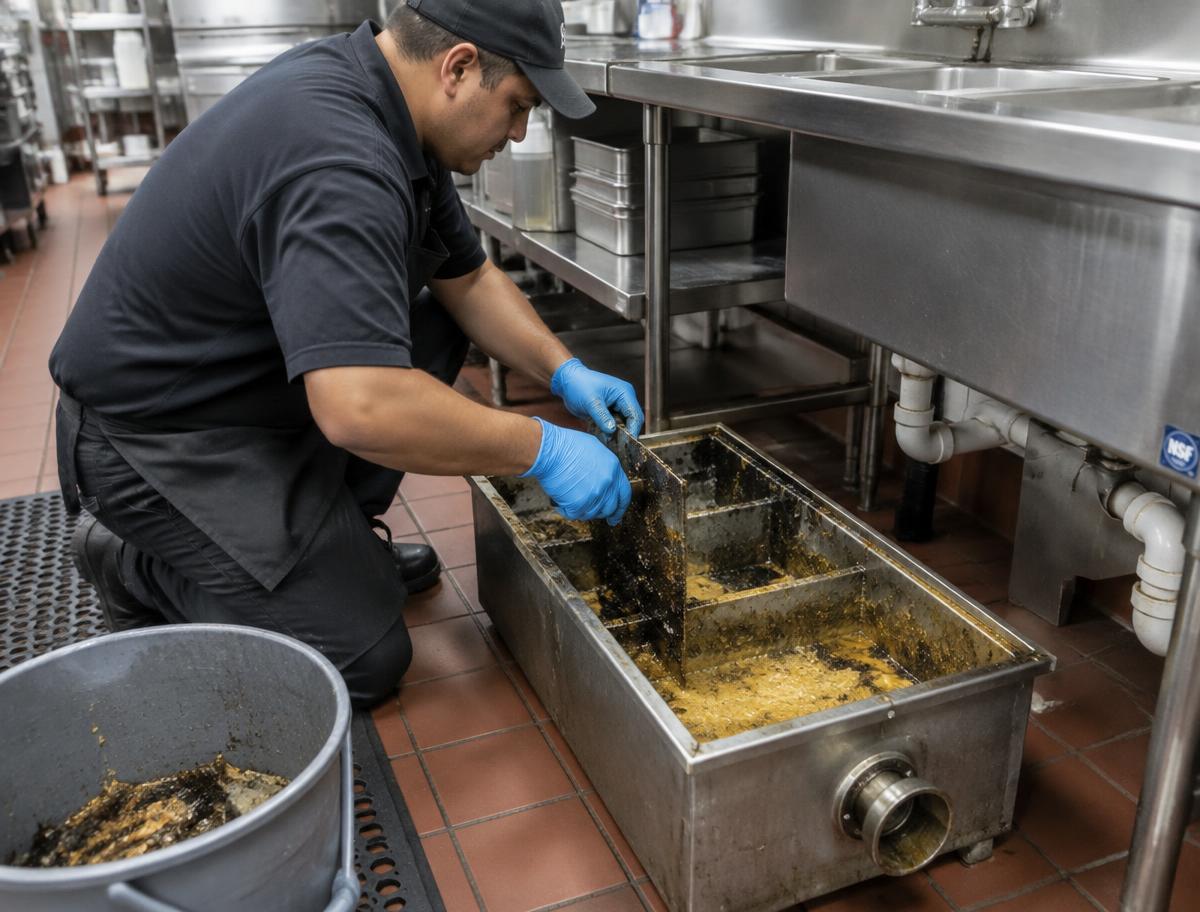
Our technicians pump out all liquids and solids, scrape the walls and baffles, check the inlet and outlet tees, test flow, and leave the area clean. You get a dated service record you can hand to an inspector the same day.
Prevent expensive plumbing backups
A clogged grease trap can cause wastewater to drain slowly, return through floor sinks or overflow into kitchen work areas. In severe cases staff can't use sinks or dishwashers until the problem is fixed. Preventative maintenance catches accumulating waste before it becomes an emergency.
Reduce unpleasant grease trap odors
Grease traps hold food particles, grease and organic wastewater. As these break down they create strong odors that affect employees and customers. Complete cleaning removes the grease, sludge and food waste behind those smells.
Protect your business from unexpected downtime
An overflowing trap during a busy lunch or dinner service disrupts staff, inconveniences customers and adds emergency costs. Routine cleaning is predictable and can be scheduled during slower hours.
Understanding the 25% grease and solids rule
The 25% rule is a common maintenance benchmark: when floating grease plus settled solids reach 25% of the unit's liquid depth, it's time to clean. For example, 15% grease plus 12% solids equals 27% — cleaning is needed. Individual wastewater authorities, including the City of San Diego, publish their own limits, so always follow your permit conditions.
Signs your grease trap needs immediate attention
Watch for slow drains, strong or recurring odors near sinks and floor drains, grease or sludge near the outlet, water backing up through floor sinks, repeated blockages after cleaning, and missed service appointments. If you notice any of these, call us right away.
Our 5-step grease trap cleaning process
1) Inspect the trap, inlet, outlet and baffles. 2) Vacuum out all grease, wastewater and settled solids — not just skim the top. 3) Clean interior walls and accessible components. 4) Check baffles and internal parts and report any damage. 5) Secure the lids and document the service with dates, waste removed, observations and photos where available.
San Diego County grease trap regulations and FOG compliance
The County Department of Environmental Health and Quality oversees food safety, while local wastewater agencies run FOG programs. The City of San Diego's Food Establishment Wastewater Discharge (FEWD) Program requires permits, proper grease removal equipment, complete pumping and cleaning records kept on site. Chula Vista, Carlsbad, Oceanside, El Cajon, Escondido and other cities have their own rules — Chula Vista, for example, sets a minimum three-month cleaning interval.
Indoor traps, underground interceptors and low-clearance service
We clean small indoor and hydromechanical grease traps, pump large underground interceptors for hotels, food courts and institutions, and offer low-profile vacuum truck service for interceptors in parking structures and garages where standard trucks don't fit.
Emergency grease trap cleaning and overflow response
Backups don't wait for business hours. We offer 24/7 emergency service, subject to dispatch and equipment availability, for urgent grease trap and interceptor problems.
One company for grease traps and used cooking oil
Instead of juggling separate vendors, combine grease trap cleaning, interceptor pumping, used cooking oil collection and baffle repair with San Diego Grease Co by TGC — one schedule, one point of contact and often lower overall costs.
Serving restaurants and facilities throughout San Diego County
We work with independent and chain restaurants, hotels, resorts, schools, universities, hospitals, senior living, supermarkets, shopping centers, catering kitchens and food production facilities — from Downtown, La Jolla and Pacific Beach to Oceanside, Carlsbad, Escondido, El Cajon, Chula Vista and Otay Mesa.
How often should a grease trap be cleaned?
For many high-use kitchens, every 30 to 60 days is a starting point for smaller traps; larger gravity interceptors are often evaluated for quarterly maintenance. These are planning guidelines, not universal legal requirements. Your equipment, waste accumulation and local wastewater authority determine the appropriate schedule.
Before & After
Indoor Grease Trap Cleaning — Real Results
These indoor service photos show heavy grease accumulation before cleaning and the exposed interior after pump-out. A trap full of wastewater is not the same as a trap full of grease and solids.
Above-floor indoor grease trap
Recessed kitchen grease trap
The after photos show the traps after pump-out, before returning to their normal operating water level. They are not meant to stay dry during use. Photos have been lightly adjusted for clarity; the equipment and recorded conditions have not been altered.
Know Your Grease Trap
Water at the fill line does not mean your trap is full of grease.
An indoor grease trap normally holds water. What matters is how much grease and settled waste has accumulated — and whether wastewater can flow freely through the outlet.
The normal fill line
After a trap is emptied, water sent down a connected drain refills it to its normal operating level. That level is controlled by the outlet elevation and is usually near the inlet and outlet connections; exact heights depend on the model and installation. Once that level is reached, incoming water displaces water through the outlet toward the sewer. Follow the manufacturer's refill instructions after cleaning.
Gravity does the separating
Conventional indoor grease traps separate waste passively — there is no powered mechanism doing the separation. Flow is slowed and directed by baffles: lighter fats, oils and grease rise to the top, heavier food solids settle to the bottom, and water flows out between those layers. Some models have flow controls or other components, but the separation itself relies on gravity and differences in density.
Overflow is a warning, not a normal fill level
If the outlet, internal passage or downstream sewer line is blocked or obstructed, liquids cannot leave fast enough. Continued incoming wastewater can raise the level above normal and cause an overflow or backup. Excessive incoming flow or other plumbing faults can also cause trouble. Water spilling out or backing up into fixtures needs prompt attention — not simply an assumption that the trap is holding its normal amount of water.
Prevent buildup before it becomes a plumbing emergency
Regular, complete grease trap service removes floating grease and settled solids before they restrict flow or carry into downstream plumbing. Neglected traps can lead to costly wastewater cleanup, professional drain-clearing charges and lost kitchen operating time. A blockage beyond the trap may require a qualified plumbing provider; pumping alone does not guarantee that a sewer obstruction is cleared.
If wastewater is overflowing, stop using connected fixtures, keep people away from the spill and call for service. Do not open, reach into or enter a grease trap to investigate it yourself.
Why Choose Us
The #1 Grease Management Team in San Diego County
Licensed Experts
Licensed, insured technicians with transparent reporting on every visit.
Fast Response
Same-day and emergency service to minimize downtime and backups.
Local Knowledge
We know San Diego County FOG rules, inspectors and sewer agencies.
Full Service
Cleaning, pumping, repair and oil pickup — one vendor.
Advanced Equipment
Modern vacuum trucks and jetters that won't damage your plumbing.
Reliable Scheduling
We track your dates so you never fall out of compliance.
Our Process
Simple, Fast & Fully Documented
Initial Inspection
We assess your traps, baffles and drains to find the most effective cleaning method.
Professional Cleaning
Our licensed team removes grease, sludge and debris, restoring full function.
Final Verification
Systems are flow-tested, inspected and documented for health-code compliance.
Areas We Serve
Grease Trap Cleaning Throughout San Diego County
Pick your city for local service details.
Central San Diego
North County Coastal
North County Inland
East County
Reviews
What San Diego Restaurant Owners Say
“I appreciate their fast response, excellent service, and fair pricing. Other companies failed me, but San Diego Grease Company earned my trust long-term.”
Khoo Teng
Restaurant Owner, Chula Vista
“Amazing response time and service. After calling eight companies, they acted fast, were knowledgeable, fairly priced, and are now my go-to grease company.”
David Volk
Restaurant Owner, San Diego
“Excellent company and service. After years of poor oil pickup, they responded same day, cleared everything efficiently, and truly earned five stars.”
Kristian Mir
Kitchen Manager, Oceanside
FAQ
Grease Trap Cleaning FAQs
Is my grease trap full if water is at the fill line?+
Not necessarily. A grease trap normally holds water at an operating level set by its outlet. After pump-out, water from a connected drain refills it to that level. Cleaning needs depend on the accumulated grease and settled solids, not the presence of water alone. Follow the manufacturer's refill instructions.
Why is my grease trap overflowing?+
A blockage or obstruction in the trap outlet or downstream plumbing can prevent wastewater from leaving, causing it to rise above its normal operating level. Excessive incoming flow or other plumbing faults can also contribute. Stop using connected fixtures and call for service; a downstream blockage may require a qualified plumbing provider.
How often does a restaurant need grease trap cleaning?+
The schedule depends on capacity, wastewater volume, grease accumulation and your wastewater authority. Many high-use kitchens start with a 30- to 60-day interval for smaller traps, then adjust based on conditions and applicable requirements.
Is grease trap cleaning required by law in San Diego?+
Food facilities must maintain functioning plumbing and wastewater systems. Local FOG programs may also require permits, grease removal equipment, cleaning schedules and service records. Check the authority responsible for your property.
Can restaurant employees clean their own grease traps?+
Permitted methods depend on the equipment and local wastewater rules. Removed waste must be handled and disposed of properly. Larger interceptors generally require professional pumping equipment.
What is the difference between a grease trap and an interceptor?+
A grease trap often means a smaller device serving specific kitchen fixtures. A gravity grease interceptor is usually a larger underground unit receiving wastewater from multiple fixtures. Terminology varies by equipment and jurisdiction.
Will grease trap pumping fix a clogged drain?+
Not necessarily. Pumping removes waste from the trap or interceptor. A separate blockage downstream may need evaluation by a qualified plumbing provider.
Do you provide emergency grease trap cleaning?+
Yes. Emergency service is available 24/7, subject to dispatch and equipment availability. Call our team to discuss your location and the condition of your system.
Can you collect our restaurant’s used cooking oil too?+
Yes. Used cooking oil collection and grease trap cleaning can be coordinated through TGC. Fryer oil and grease trap wastewater are separate waste streams and must be collected and handled separately.
How much does grease trap cleaning cost?+
Pricing depends on equipment size, waste accumulation, site access and service frequency. Contact us for a free quote specific to your facility.
All Services
Complete Grease Services Across San Diego County
Licensed services for restaurants, commercial kitchens and facilities.
Grease Trap Cleaning
Scheduled and emergency grease trap cleaning that keeps kitchens compliant, odor-free and flowing.
View ServiceGrease Interceptor Cleaning
Complete pumping and cleaning for underground tanks, shared restaurant systems and parking garage interceptors.
View ServiceUsed Cooking Oil Collection
Scheduled fryer oil pickup, secure containers, bulk oil removal and recycling for San Diego County businesses.
View ServiceBaffle T Repair
Inspection and repair of accessible grease interceptor baffles and inlet and outlet tees.
View ServiceBook Grease Trap Cleaning Today
Talk to a local grease expert today. Free quotes, fast scheduling, no long-term contracts.